
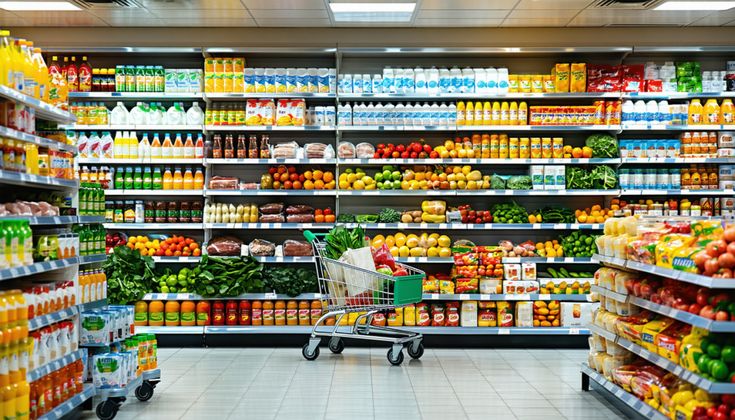
The Psychology of Grocery Shopping
You're Not in Control
of Your Trolley
Every product you pick up, every offer you can't resist, every aisle you wander down — it's all by design. Here's the science behind why we buy what we buy, and how to finally shop on your own terms.
The average British shopper spends 41 minutes in a supermarket. They will make over 60 individual purchasing decisions. And research consistently shows that fewer than a third of those decisions were planned before they walked in. The rest? Triggered, nudged, anchored, and engineered — by some of the most sophisticated behavioural science money can buy.
Grocery retailers invest hundreds of millions of pounds every year in understanding exactly how your brain works under the artificial lighting of a supermarket floor. They know when you're most likely to impulse buy, what colours make you feel fresh versus indulgent, how long you'll stand in front of a shelf before giving up, and precisely which position on a shelf your eyes land on first.
This is not a conspiracy. It is applied psychology — and understanding it is the first step to actually shopping the way you intend to, not the way you've been guided to. Let's pull back the curtain.
Anchoring is one of the most powerful and most exploited cognitive biases in retail. The human brain doesn't evaluate prices in absolute terms — it evaluates them relative to the first number it sees. This is your "anchor."
When a supermarket puts a product on the shelf with a crossed-out price of £5.99 and a current price of £3.99, your brain doesn't ask "is £3.99 a fair price for this item?" It asks "am I saving £2?" The answer feels like yes. The sale feels real. But in many cases, the original price was artificially inflated specifically to create the anchor — a practice that has been the subject of multiple UK Trading Standards investigations.
Premium products also use anchoring strategically. Placing a £12 bottle of olive oil next to a £7 bottle makes the £7 bottle seem reasonable — even if you'd never have paid £7 for it without the comparison. The £12 item exists not to sell, but to anchor.
The fix: Always ask yourself what you'd pay for this item if there was no comparison price visible. Research a product's actual market value before shopping. At Herbs & Beans, our prices reflect wholesale cost plus a transparent margin. There is no crossed-out fiction.
Daniel Kahneman's Nobel Prize-winning research established something counterintuitive about the human brain: losses feel roughly twice as painful as equivalent gains feel good. Losing £10 hurts more than gaining £10 pleases you. Retailers have exploited this asymmetry for decades.
When you see "Buy 2 Get 1 Free," your brain doesn't process it as an opportunity. It processes it as a potential loss — specifically, the loss of the free item you'd be leaving behind by only buying one. You weren't planning to buy three jars of pasta sauce. But leaving without the free one now feels like losing something you already owned.
The result? You spend more, often on products that will expire in your cupboard. UK food waste statistics tell this story plainly — British households throw away £1,000 of food per year on average, and multi-buy promotions are a significant contributor.
The fix: Before accepting any multi-buy, ask: would I have bought this quantity without the deal? If no, you're not saving money — you're spending more. Only bulk-buy products you genuinely use before they expire.
Supermarkets are engineered sensory environments. Nothing is accidental. The in-store bakery — increasingly rare as a genuine operation, more often a semi-bake facility — is positioned near the entrance not for operational convenience but because the smell of fresh bread triggers a primal comfort response that makes shoppers feel at ease, reduces cognitive guard, and increases overall basket spend by an average of 15–20%.
The same logic applies to sound. Research found that slow-tempo background music increases time spent in-store by 38%, directly correlating with higher spend. Bright, clinical lighting in the fresh produce section makes vegetables appear more vibrant. Warm lighting over the deli counter makes cured meats look richer. Every sense is a lever. The grocery store is not a shop — it is a curated psychological experience designed to lower your defences.
The fix: Shop with a list, shop with headphones in, and if possible — shop online. Removing the sensory environment removes most of its power over you entirely.
The supermarket floor is not a shop. It is a psychological machine — built by neuroscientists, behavioural economists, and retail architects — to extract the maximum from every visit.
— Herbs & Beans Insight SeriesShelf placement is not neutral — it is sold. Major consumer goods brands pay supermarkets significant "slotting fees" to secure eye-level and end-of-aisle positions, which consistently deliver 30–40% higher sales than bottom-shelf placement. What you reach for first is not what you chose — it's what a brand paid for you to see first.
The "eye-level is buy-level" principle is particularly pronounced in cereal aisles, where children's products are deliberately placed lower — at a child's eye level — to trigger pester power. The lowest shelves, the back corners, the far ends of aisles — these are where the genuinely good value products often live. Not because retailers are rewarding you for looking, but because no one has paid to put them anywhere better.
The fix: Consciously look above and below eye level when comparing products. The best value is almost always not at the centre of your vision. Search by price-per-unit, not by shelf position.
Neuroscience research estimates that approximately 45% of our daily behaviours are habits — automatic routines executed without conscious deliberation. Grocery shopping is one of the most habitual activities in modern life. Most British shoppers visit the same store, take the same route through the aisles, and pick the same products week after week — not because they've made a considered decision, but because their brain has automated the process.
The habit loop — cue, routine, reward — means that the cue (entering the cereal aisle) triggers the routine (reaching for the familiar box) before any evaluation occurs. The reward (familiarity, perceived safety) then reinforces the loop. Breaking it requires a conscious pause that most shoppers, moving through an overwhelming environment, simply don't take.
The fix: Periodically audit your shopping list and ask honestly: when did I last consider whether this is the best product for this purpose? Habit reviews — even once a quarter — can unlock significant savings and quality improvements.
Humans are deeply social animals, and our purchasing behaviour reflects this at every turn. Social proof — the psychological tendency to assume that if many people are doing something, it must be the right thing to do — is one of the most consistently powerful drivers of grocery purchasing behaviour.
The "bestseller" badge, the "customer favourite" sticker, the five-star rating panel on a shelf edge — none of these communicate anything concrete about quality. They communicate popularity. Online grocery is even more susceptible. Algorithms surface products based on sales velocity, creating a feedback loop that has nothing to do with nutritional quality, value, or ethical sourcing.
The fix: Treat "bestseller" as information about what is popular, not what is best. Read ingredients lists and nutritional information. Popularity and quality are entirely separate in the grocery world.
Price Anchoring
Inflated "was" prices make current prices feel like a bargain, regardless of actual value.
Artificial Scarcity
"Limited time offer" and "while stocks last" trigger loss aversion and override rational thinking.
Decision Fatigue
After dozens of decisions, willpower depletes. Checkout zones are placed there on purpose.
Packaging Psychology
Green signals health. Gold signals premium. Red signals urgency. None of it tells you about the product inside.
The Decoy Effect
A third, slightly worse option is added to make the retailer's preferred choice look more attractive.
Trolley Size Effect
Supermarkets gradually increased trolley sizes over decades — a larger trolley signals a larger shop is normal.
How Online Shopping Changes the Psychology
The move to online grocery shopping removes many — though not all — of these triggers. You are no longer subject to the smell of bread, the sound design, the shelf positioning, or the physical fatigue of navigating a large store. But online grocery introduces its own architecture: algorithms surface what drives revenue, "frequently bought together" expands basket size, and homepage banners are paid placements, just like eye-level shelves.
| Psychological Trigger | Physical Supermarket | Standard Online Grocery | Herbs & Beans |
|---|---|---|---|
| Price anchoring with fake "was" prices | ✗ Common | ✗ Common | ✓ None |
| Paid shelf / search placement | ✗ Pervasive | ✗ Common | ✓ None |
| Sensory environment manipulation | ✗ Extensive | ✓ Absent | ✓ Absent |
| Artificial scarcity messaging | ✗ Common | ✗ Common | ✓ None |
| Transparent wholesale pricing | ✗ Never | ✗ Never | ✓ Always |
| Impulse purchase zones | ✗ At checkout | ✗ Algorithm-driven | ✓ None |
What shopping looks like when the psychology is removed
We built Herbs & Beans on a foundational belief: shoppers deserve to make genuinely free decisions about their groceries — without being manipulated into spending more. Our model is direct wholesale, and our pricing reflects that completely.
- No crossed-out anchor prices. Every price is a real, current wholesale-connected price.
- No paid placement in search or on homepage — products surface by category and relevance.
- No artificial scarcity. "Limited time" offers don't exist in our store.
- No algorithmically inflated "frequently bought together" to expand your basket artificially.
- No loyalty scheme designed to obscure whether you're actually getting value.
- Clear unit pricing on everything, so you can always make a real comparison.
The best grocery shopping experience is one where you leave with exactly what you needed, at a price that genuinely reflects what the food costs — nothing more. That's what we're building at Herbs & Beans. One transparent transaction at a time.
Shop Without the Mind Games
Groceries the Way They Should Be — Honest, Direct, Fair
No anchored prices. No paid placements. No manipulation. Just great groceries at wholesale prices, delivered to your door across the UK.
Shop Herbs & Beans →